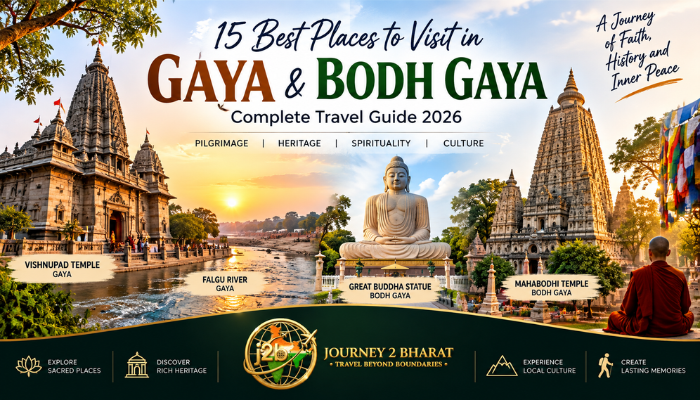
15 Best Places to Visit in Gaya & Bodh Gaya
Gaya and Bodh Gaya are among Bihar’s most important destinations for spiritual, religious, historical and cultural travel. Gaya is especially known for the Vishnupad Temple and Pind Daan rituals, while nearby Bodh Gaya is internationally famous as the place associated with Gautama Buddha’s enlightenment.
For travellers looking for a combination of Hindu pilgrimage, Buddhist heritage, ancient caves and peaceful spiritual experiences, the Gaya–Bodh Gaya circuit can easily become a 2–3 day trip.
Here are the 15 best places to visit in Gaya and Bodh Gaya in 2026.
Gaya: Places to Visit
1. Vishnupad Temple
The Vishnupad Temple is one of the most important pilgrimage sites in Gaya. Located near the Falgu River, the temple is famous for the footprint believed by devotees to be that of Lord Vishnu.
Gaya has traditionally been associated with Pind Daan and ancestral rituals, making Vishnupad one of the main places visited by pilgrims. The present temple was renovated in the 18th century under Queen Ahilyabai Holkar.
Best for: Hindu pilgrimage, Pind Daan and spiritual travel.
2. Mangla Gauri Temple
Located on a hill in Gaya, Mangla Gauri Temple is an important Shakti pilgrimage site. It is traditionally associated with the Shakti Peeth tradition and is one of the prominent religious attractions of the city.
The temple's elevated location also offers a different perspective of Gaya's historic landscape.
3. Akshayavat
Near Vishnupad Temple is Akshayavat, a sacred banyan tree associated with Hindu religious traditions.
It is an important stop for pilgrims performing ancestral rituals in Gaya and is generally included with the Vishnupad and Falgu River pilgrimage circuit.
4. Sita Kund
Located across the Falgu River from Vishnupad Temple, Sita Kund is associated with the traditional story of Sita performing Pind Daan for her father-in-law.
It is particularly relevant for visitors coming to Gaya for religious and ancestral rituals.
5. Surya Kund
Surya Kund is another religious site associated with Gaya's pilgrimage landscape. Devotees visit the area as part of the broader sacred circuit around the city.
If you are exploring Gaya primarily for its religious heritage, it can be included along with Vishnupad, Sita Kund and Akshayavat.
6. Ramshila Hill
Ramshila Hill is one of the hills surrounding Gaya and has strong religious significance.
The hill is associated with Lord Rama and is visited by pilgrims as part of Gaya's traditional religious circuit. Gaya's surrounding hills—including Mangla Gauri, Ramshila and Brahmayoni—are an important part of the city's landscape.
7. Brahmayoni Hill
For travellers who enjoy a combination of spirituality and views, Brahmayoni Hill is worth including.
The hill is connected with Gaya's religious traditions and provides an elevated view of the surrounding area. It can be a rewarding stop for visitors who want something beyond temples.
8. Dungeshwari Hills / Mahakala Caves
The Dungeshwari Cave Temples, also known as the Mahakala Caves, are particularly significant for Buddhist travellers.
According to tradition, Siddhartha Gautama spent years practising severe meditation and asceticism here before travelling to Bodh Gaya. The caves contain Buddhist shrines and are associated with the period before his enlightenment.
Tip: Although Dungeshwari is commonly included in a Gaya–Bodh Gaya itinerary, it is closer to the Bodh Gaya side of the circuit.
Bodh Gaya: Places to Visit
9. Mahabodhi Temple
The Mahabodhi Temple is the heart of Bodh Gaya and one of the most important Buddhist pilgrimage sites in the world.
It marks the place traditionally associated with Buddha's enlightenment under the Bodhi Tree. The Mahabodhi Temple Complex was inscribed as a UNESCO World Heritage Site in 2002.
The complex includes the Mahabodhi Temple, Bodhi Tree, Vajrasana and several other sacred locations connected with Buddha's life after enlightenment.
Best for: Buddhist pilgrimage, meditation, architecture and history.
10. Bodhi Tree & Vajrasana
Inside the Mahabodhi Temple complex, the Bodhi Tree is one of the most spiritually significant places in Bodh Gaya.
The Vajrasana, or Diamond Throne, marks the traditional spot where Buddha is believed to have meditated and attained enlightenment.
11. Great Buddha Statue
The 80 Feet Buddha Statue is one of Bodh Gaya's most recognisable landmarks.
The approximately 25-metre statue was consecrated in 1989 and stands close to the Mahabodhi Temple. Bihar Tourism notes that it is around 2 km from the Mahabodhi Temple and easily accessible by local transport.
12. Thai Monastery
The Thai Monastery showcases Thailand's influence on Bodh Gaya's Buddhist heritage.
Its distinctive Thai architectural style, Buddha image and peaceful surroundings make it one of the most attractive international monasteries in the town.
13. Tibetan Monastery
The Tibetan Monastery is another important stop for visitors exploring Bodh Gaya's international Buddhist culture.
Bodh Gaya attracts Buddhist pilgrims and visitors from different parts of Asia and the world, and its monasteries reflect this international character. The Gaya district administration lists Tibetan, Thai, Chinese, Burmese, Bhutanese and Japanese Buddhist establishments among Bodh Gaya's attractions.
14. Sujata Village & Sujata Garh
Just a short distance from Mahabodhi Temple, Sujata Village is associated with one of the important stories from Buddha's journey toward enlightenment.
According to tradition, Sujata offered food to Siddhartha after his period of extreme asceticism. The nearby Sujata Garh is an ancient stupa associated with this tradition. It is approximately 2 km from the Mahabodhi Temple.
15. Bodh Gaya Archaeological Museum
If you are interested in history and archaeology, add the Bodh Gaya Archaeological Museum to your itinerary.
The museum houses Buddhist and Hindu archaeological objects recovered from Bodh Gaya and surrounding excavation sites.
Best Time to Visit Gaya & Bodh Gaya
The most comfortable period for a Gaya–Bodh Gaya trip is generally October to March, when the weather is more suitable for sightseeing and outdoor exploration.
For Buddhist travellers, the winter months are particularly pleasant for visiting temples and monasteries.
If your purpose is Pind Daan during Pitru Paksha, however, your travel dates should be planned around the annual Pitru Paksha period rather than simply choosing the coolest months.
How to Reach Gaya & Bodh Gaya from Patna
By Road
Gaya is approximately 100 km south of Patna, according to the Gaya district administration. Bodh Gaya is farther along the same general travel corridor, with the exact road distance depending on the route.
A private car or taxi is one of the most convenient options if you want to cover both Gaya and Bodh Gaya in one trip.
By Train
Gaya Junction is the major railway station serving the region. From Gaya, travellers can take a taxi, auto or other local transport towards Bodh Gaya.
By Air
Gaya International Airport is the closest airport to Bodh Gaya and is approximately 7 km away from the town. Patna remains another major airport option for travellers coming from other parts of India.
Suggested 2-Day Gaya & Bodh Gaya Itinerary
If you have an additional day, add Dungeshwari Hills and the Mahakala Caves for a deeper Buddhist experience.
Planning a Bodh Gaya Spiritual Trip?
If you want a professionally planned Buddhist pilgrimage covering Bodh Gaya and other important spiritual destinations, explore Journey 2 Bharat's Bodhgaya Spiritual Tour Package.
From sightseeing and transportation to itinerary planning, a structured tour can make your Gaya–Bodh Gaya journey much easier.
Final Thoughts
Gaya and Bodh Gaya offer a rare combination of Hindu pilgrimage, Buddhist spirituality, ancient history and cultural heritage within a relatively compact travel circuit.
Whether you are visiting Gaya for Pind Daan and Vishnupad Temple, travelling to Bodh Gaya to experience the Mahabodhi Temple, or exploring the caves and monasteries connected with Buddha's journey, this part of Bihar offers an experience that goes far beyond ordinary sightseeing.
If Bihar is on your travel list in 2026, put Gaya and Bodh Gaya high on it.